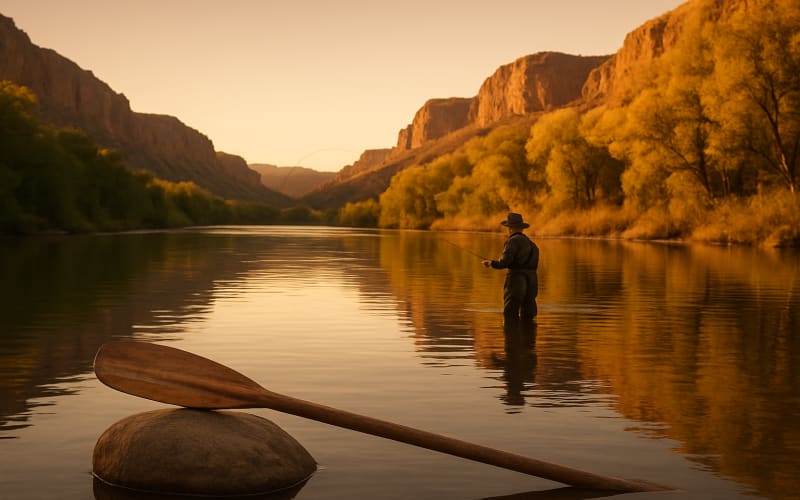
A New Study Puts a Dollar Figure on What Rivers, Lakes, and Streams Actually Deliver
Arizona is known for its desert. Saguaro cacti, red rock formations, and scorching summers are the images most people carry around in their heads when they think of the state. But there's another side to Arizona that doesn't get nearly enough credit — its water. Rivers cutting through canyon country, high-elevation streams tucked into the White Mountains, desert lakes baking under open skies. And now, for the first time, someone has actually sat down and counted what all of that is worth.
The answer is staggering.
A new report released by Audubon Southwest, the regional office of the National Audubon Society covering Arizona and New Mexico, puts the total economic output generated by water-based outdoor recreation in Arizona at $11.7 billion every single year. That's not a rough estimate or a ballpark figure — it's the result of a detailed analysis conducted alongside Southwick Associates, a research firm that specializes in the outdoor recreation industry.
The findings land with real weight when you stack them up against other parts of Arizona's economy. Golf, which most people would consider a cornerstone of the state's recreational identity, generates around $6 billion in economic output. The wine industry brings in approximately $5.7 billion. Water-based outdoor recreation beats both of them — combined — and it isn't particularly close.
What the Study Actually Measured
The analysis looked at participation and spending tied to a specific set of activities that take place on or along Arizona's rivers, lakes, and streams between September 2024 and August 2025. That included fishing, hunting, camping, hiking and trail sports, wildlife watching, picnicking, cycling, and water sports like kayaking, rafting, canoeing, swimming, paddleboarding, and boating.
To be clear about what this study was trying to do: it wasn't measuring the value of water in the abstract. It was measuring what happens economically when people show up to use that water. As Haley Paul, Senior Policy Director for Audubon Southwest, put it, "Water-based outdoor recreation is a helpful way to measure the economic contributions of the water in our rivers, lakes, and streams because without water, much of the economic activity would cease. People don't fish in dry lakes or kayak in dry riverbeds."
That framing matters. The dollar figures attached to this study aren't just about fun — they're about what disappears if the water does.
The Numbers Behind the Numbers
The $11.7 billion in total economic output is the headline, but the supporting figures are just as telling.
Residents of Arizona and visitors to the state collectively spent $9.7 billion on water-related outdoor recreation within the state's borders. That money flows into gear shops, gas stations, restaurants, hotels, campgrounds, guide services, and dozens of other businesses that depend on people getting outside and near the water.
On the employment side, water-based outdoor recreation supports more than 72,000 jobs across Arizona. Those aren't temporary or marginal positions — the wages tied to those jobs total nearly $4 billion annually. When recreation along water is factored into the state's Gross Domestic Product, it adds more than $6.9 billion to that figure.
For comparison, mining in Arizona generates more total economic output at roughly $21.2 billion, but water-related outdoor recreation actually supports more employment statewide. That's a significant distinction. Jobs mean people, families, mortgages, grocery bills, and local tax revenue. The outdoor recreation industry, driven in large part by access to water, is punching well above its weight when it comes to putting Arizonans to work.
Who Is Actually Out There
More than 2.2 million Arizona residents participate in at least one outdoor recreational activity on or along water in the state. That represents nearly 39 percent of the state's entire adult population. This isn't a niche hobby or a seasonal quirk — it's something close to half of all adults in the state regularly choosing to spend their time near rivers, lakes, and streams.
When those residents were asked what drew them out there, the most popular activity was picnicking and relaxing outdoors, cited by 21.4 percent of participants. Water sports came in second at 14.1 percent. Fishing ranked third at 12.2 percent. The breakdown shifts depending on where in the state you look, which reflects how dramatically Arizona's landscape changes from one region to the next.
As Lena Allen, Director of Stewardship for the Arizona Office of Tourism, explained: "This new study confirms what residents and our tens of millions of visitors have already experienced. There's a magnetic pull to water in Arizona, especially since we're so closely associated with the desert. From the mighty Colorado River to the gentle streams of the White Mountains and the cottonwood-lined San Pedro River, water here delivers life and economic success for communities statewide."
That magnetic pull isn't just poetic language. It shows up in the data.
What It Means at the County Level
One of the more useful aspects of this report is that it doesn't stop at the state level. The analysis breaks down economic contributions county by county, which gives local governments and community leaders something concrete to work with when making decisions about land use, water rights, and conservation funding.
Yavapai County is one example worth looking at closely. Water-based recreation in that county alone generates $720 million in economic output and supports 4,500 jobs within the state. Much of that activity centers on the Verde River, a free-flowing river that runs through the heart of the county and serves as the backbone of the region's outdoor economy.
Cottonwood Mayor Ann Shaw spoke directly to what that river means for her community: "This report provides significant insight into the economic benefits that the Verde River provides in terms of recreation for the City of Cottonwood and all of its Yavapai County neighbors who recognize and rely on this free-flowing Arizona river as a life-source and habitat, not just for the wildlife that the National Audubon Society works so diligently to preserve, but for all of us who thrive along its banks."
That sentiment — thriving along the banks — captures something real about the relationship between water and community in the West. It's not just scenic. It's structural.
The Bigger Picture
Arizona has spent decades managing the tension between growth, water supply, and the natural landscape. Population centers like Phoenix and Tucson have expanded dramatically, and water policy debates are never far from the surface in a state where drought is a recurring reality and aquifer levels are closely watched.
What this report adds to that conversation is a clear economic argument for protecting the water that feeds these recreational ecosystems. The Colorado River, the Verde, the Salt, the San Pedro, the streams threading through the White Mountains — these aren't just habitat corridors for birds and fish. They are economic engines generating billions of dollars in output, tens of thousands of jobs, and nearly $4 billion in wages for working people across the state.
The outdoor recreation industry has long argued that healthy landscapes are good for the bottom line. This study gives that argument a specific, credible number attached to one of the most resource-constrained states in the American West. When water flows, people come. When people come, they spend money. When they spend money, communities grow stronger.
That's not a complicated story. But it's one that Arizona — and the people making decisions about how to manage its water — now has the data to tell.
The full technical report, along with individual county fact sheets and an executive summary, is available at audubon.org/azrivers.