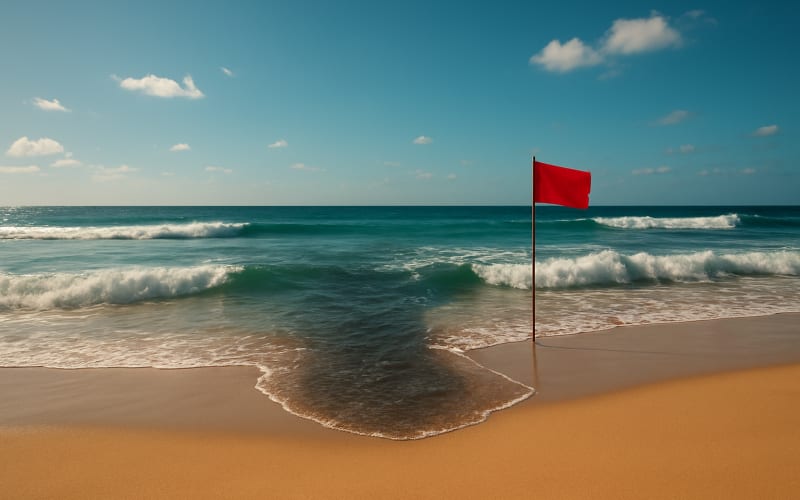
Every summer, thousands of Americans head to the beach expecting fun, sun, and good memories. And for most of them, that's exactly what they get. But every single year, rip currents claim around 100 lives in the United States alone, and that number would be a whole lot lower if more people understood what they're dealing with. These things don't look like much from the shore. There's no dramatic whirlpool, no warning siren, no obvious sign that the water right in front of you could be genuinely life-threatening. That's what makes them so dangerous.
Let's break down what rip currents actually are, why they form, and most importantly, what to do if one grabs you.
What Exactly Is a Rip Current?
A rip current is a narrow, fast-moving channel of water that flows away from the shore, out toward open ocean. Think of it like a river running through the surf. It's not pulling you under — and this is a huge misconception — it's pulling you out. Horizontally. Away from the beach.
These currents can move at speeds up to eight feet per second. To put that in perspective, that's faster than an Olympic swimmer at full sprint. So if you're fighting one head-on, trying to swim straight back to shore, you're going to lose. Every time. That's the trap most people fall into, and it's why panic sets in so fast.
Rip currents are not the same as undertow, either. Undertow pulls at your legs near the shoreline where waves are breaking. A rip current is a distinct, organized flow that extends from the shoreline out past the breaking waves. Different animal entirely.
How Do Rip Currents Form?
Here's where it gets kind of interesting. Rip currents are basically the ocean trying to balance itself out.
When waves roll in toward the shore, they push water up onto the beach. That water has to go somewhere — it can't just keep piling up. So it flows along the shore in both directions until it finds a weak point in the wave pattern, usually a gap in a sandbar, a break in a reef, or a spot near a pier or jetty. Once it finds that gap, all that water rushes outward in a concentrated stream. That's your rip current.
Sandbars shift constantly. Storms, tides, and wave action all reshape the underwater landscape on a daily basis. So a stretch of beach that was perfectly safe last weekend might have a nasty rip running through it by Wednesday. This is why lifeguards matter. They're watching the water all day and they see things that regular beachgoers just don't notice.
Certain conditions make rip currents more likely to form. Large surf, swell from distant storms, and strong onshore winds all increase the odds. After a hurricane passes offshore, even beaches hundreds of miles away can develop dangerous rip currents. The ocean is connected, and what happens out there eventually shows up at the shoreline.
Spotting a Rip Current Before It Grabs You
Learning to identify a rip current from the beach is one of the most valuable skills you can have before you ever step into the water. Here's what to look for:
Discolored water. Rip currents often look different from the water around them. They can appear darker, murkier, or choppier. Sometimes you'll see a streak of brown or greenish water cutting through the blue — that's sand and sediment getting pulled out.
Choppy, irregular surface. The water in a rip looks unsettled compared to the waves around it. There's a churn to it that doesn't quite match the rhythm of the surf.
A gap in the breaking waves. Look for a section of beach where the waves aren't breaking as tall or as consistently. That flat-looking patch might actually be where water is rushing out.
Foam or debris moving seaward. If you see a line of foam, seaweed, or floating stuff moving steadily away from shore, that's a textbook sign of a rip current in action.
If you're ever unsure, ask a lifeguard before you get in the water. I mean it. I spent years thinking asking felt like admitting you didn't know what you were doing. At a beach in North Carolina years back, I walked right past a lifeguard stand before getting in the water near a jetty. The guy jogged down and flagged me off before I got knee-deep. Turns out there was a strong rip running right along that structure. I would have been in serious trouble about sixty seconds later. That lifeguard probably saved me from a very bad afternoon. Ask the lifeguard. Swallow your pride.
What to Do If You Get Caught in One
Alright, this is the part that actually saves lives, so pay attention.
Do not panic. Easier said than done, I know. But panic burns energy, leads to poor decisions, and can cause even strong swimmers to go under. If you feel the current pulling you, take a breath and think.
Do not swim against it. This is the number one mistake people make. Swimming directly back toward shore when you're in a rip current is like trying to run up a down escalator at full speed. You'll exhaust yourself fast, and the current won't give an inch. People drown this way because they keep fighting until they have nothing left.
Swim parallel to the shore. The current is narrow, usually no more than 100 feet wide. If you swim sideways — parallel to the beach — you'll cross out of the current's channel relatively quickly. You don't need to fight it at all. You just need to get out of it's lane.
Let it carry you if you're tired. If you're already exhausted or you're not a confident swimmer, stop fighting. Let the current take you. It will carry you out to where the waves stop breaking, and then it loses power. Once the current fades, you can calmly swim at an angle back toward the shore. Don't rush it. The current will die out on its own.
Wave for help. If you're in trouble, signal for help immediately. Raise one arm and wave. Don't try to be tough about it. People on shore and lifeguards can see you better than you think.
Float if necessary. If you're exhausted and struggling, float on your back. Conserve your energy. You can always swim once you've caught your breath. You can't swim if you've drowned.
Who's Actually at Risk?
Everyone who gets in the ocean is at some level of risk from rip currents. But some groups get hit harder than others.
Men, statistically, are disproportionately represented in rip current drownings. Part of that comes down to overconfidence — guys tend to venture out further, dismiss warning flags, and wait longer before asking for help. There's also a tendency to fight the current instead of thinking it through. Knowing that this bias exists is the first step toward not becoming a statistic.
Non-swimmers and weak swimmers are obviously at higher risk. But even strong swimmers die in rip currents every year, because strength isn't the issue. Technique and knowledge are the issue. A guy who grew up swimming laps in a pool doesn't automatically know how to handle open ocean surf. They're different things.
Children need to be watched closely in surf. A rip current that would merely inconvenience an adult could overwhelm a kid in seconds.
The Role of Warning Flags
Most developed beaches in the U.S. use a flag system to communicate water conditions. Yellow means moderate conditions — use caution. Red means high hazard, rough surf and strong currents. Double red typically means the beach is closed to swimming. Purple flags indicate dangerous marine life in the water, which is a seperate concern.
A lot of people see a red flag and still get in the water. That's a choice you can make as an adult, but go in with your eyes open about what that flag is telling you. Beach conditions that earn a red flag are not just the ocean being a little feisty. They're conditions where trained lifeguards have determined that average swimmers are in genuine danger.
Final Thought
Rip currents are serious, but they're not a death sentence if you know what you're dealing with. The ocean isn't out to get you. It's just doing what physics tells it to do, and sometimes that puts you in a bad spot. The difference between a scary moment and a tragedy is almost always knowledge and composure.
Check the flags. Ask a lifeguard. Learn to spot the warning signs from shore. And if you get caught in a rip, don't fight it — work with it, get out of the channel, and swim back in when you're clear.
Go enjoy the beach. Just respect the water while you're there.